
Machine Learning in Financial Services | Panabotics
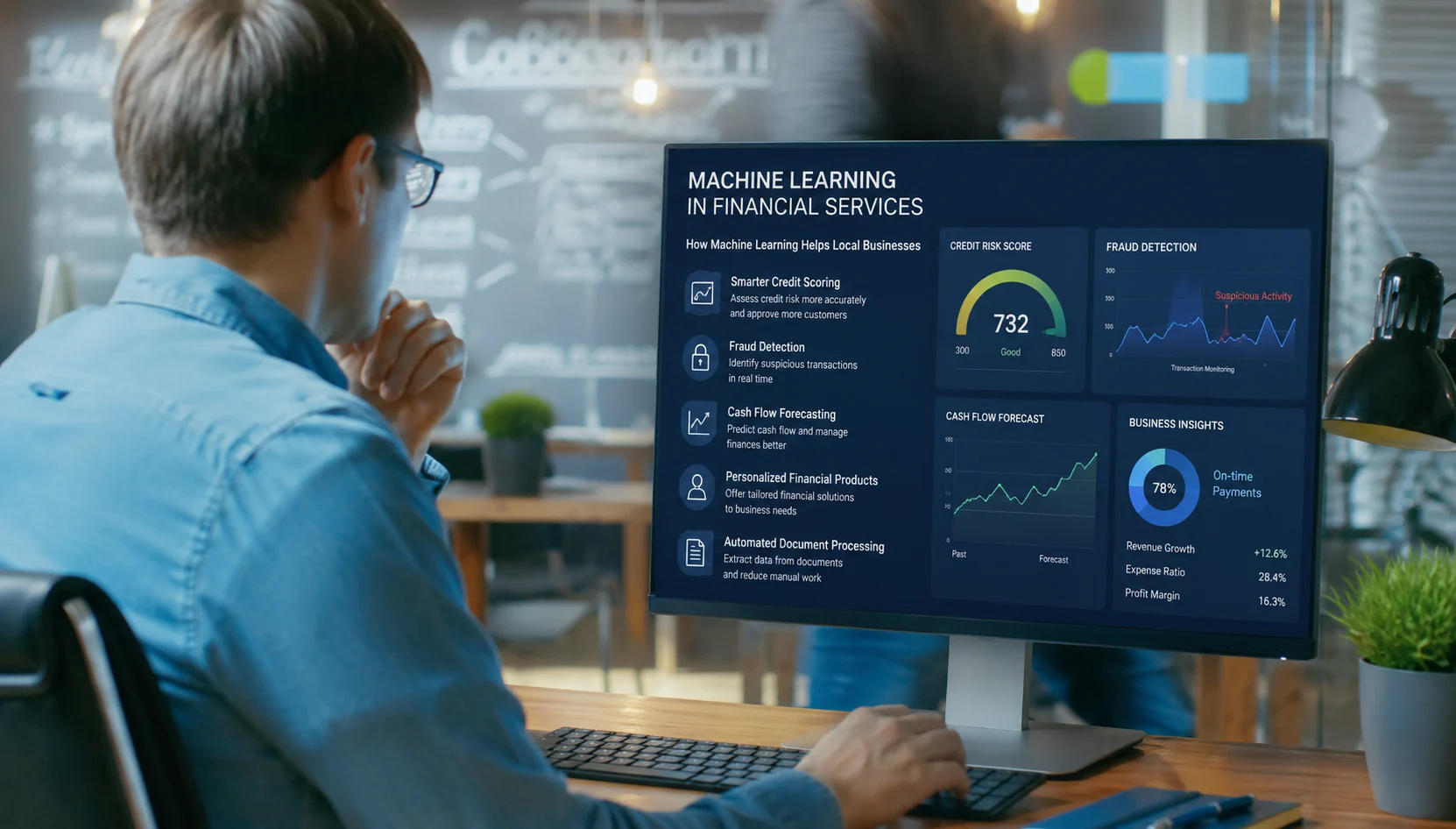
When people talk about machine learning in financial services, they usually mean JPMorgan's trading algorithms or Goldman Sachs risk models. Content written for billion-dollar institutions with data science departments and seven-figure infrastructure budgets.
That's not who this is for.
This guide is for accountants, mortgage brokers, independent financial advisors, insurance agents, and fintech founders who want a straight answer to one question: what does machine learning actually mean for my business right now?
What Is Machine Learning in Financial Services?
Machine learning is a type of artificial intelligence that learns from data to make predictions and decisions — without being manually programmed for every scenario.
In financial services, this means systems that can detect a fraudulent transaction before a human would notice, predict which customers are likely to default on a loan, or automatically categorise thousands of bank transactions in seconds.
The technology itself isn't new. What's new in 2026 is that it's no longer only accessible to large institutions. Smaller financial businesses — advisory firms, brokerages, insurance agencies, accounting practices — are now deploying the same capabilities at a fraction of the cost that was required three years ago.
6 Real Ways Machine Learning Is Being Used in Financial Services Right Now
1. Fraud Detection and Transaction Monitoring
This is the most mature use case. Machine learning models analyse transaction patterns in real time and flag anomalies — unusual spending locations, atypical transaction sizes, login behaviour that doesn't match the account holder's history.
For a small payments company or a fintech processing client transactions, this replaces what would previously have required a dedicated compliance team manually reviewing alerts. The model learns from every confirmed fraud case and gets more accurate over time.
What this means for your business: If you process payments or handle client funds, ML-powered fraud monitoring is now a realistic addition to your stack — not a six-figure infrastructure project.
2. Credit Scoring and Loan Decisioning
Traditional credit scoring uses a narrow set of inputs — payment history, debt levels, account age. Machine learning models can incorporate hundreds of variables: cash flow patterns, invoice payment speed, industry benchmarks, even behavioural signals.
This matters most for lenders and mortgage brokers dealing with clients who have thin credit files — self-employed individuals, new businesses, recent immigrants — who would be declined under a traditional model but are actually low-risk borrowers.
What this means for your business: If you work in lending or mortgage advice, ML-assisted credit tools let you serve a wider client base and make faster, more defensible decisions.
3. Document Processing and Data Extraction
Financial services runs on paperwork — contracts, tax returns, bank statements, insurance forms, compliance documents. Manually extracting data from these documents is one of the biggest time sinks in the industry.
Machine learning models — specifically a type called OCR combined with natural language processing — can read, classify, and extract structured data from unstructured documents at scale. What takes a staff member two hours takes a model two seconds.
What this means for your business: Accounting firms, mortgage advisors, and insurance brokers can automate the intake and processing of client documents — reducing admin costs and turnaround time significantly.
4. Customer Service Automation
ML-powered chatbots trained on financial services data can handle the majority of routine client enquiries — account balance questions, product comparisons, appointment booking, basic compliance queries — without human involvement.
This is not the clunky rule-based chatbot that sends people in circles. Modern financial services chatbots understand context, escalate intelligently, and learn from conversations over time.
What this means for your business: A financial advisory or insurance firm handling 100+ client messages per week can automate 60–70% of that volume, freeing advisors to focus on high-value client relationships.
5. Personalised Financial Recommendations
Robo-advisors have been doing this at scale for years. The same logic now applies to smaller advisory businesses. ML models can analyse a client's spending patterns, life stage, risk profile, and financial goals to surface timely, relevant recommendations.
For an independent financial advisor, this means being able to proactively reach clients with relevant opportunities rather than waiting for annual review cycles.
What this means for your business: Advisors using ML-assisted tools can serve more clients at a higher quality level — without proportionally increasing time spent on each relationship.
6. Regulatory Compliance and Reporting
Compliance is one of the most expensive operational burdens in financial services. Machine learning is being applied to automate transaction monitoring for AML (anti-money laundering), flag unusual patterns for regulatory review, and generate compliance reports automatically.
For smaller firms where compliance responsibility falls on senior staff, this represents a meaningful reduction in time and risk exposure.
What this means for your business: ML-assisted compliance tools are now accessible for firms of all sizes — not just those with dedicated compliance departments.
The Honest Reality: What Machine Learning Won't Fix
Machine learning is not a shortcut to better strategy. It amplifies what you already do — and that cuts both ways.
If your client data is disorganised, a machine learning model trained on it will produce unreliable outputs. If your processes are broken, automating them faster just produces errors faster.
The businesses getting the most from machine learning in financial services in 2026 are the ones who started with a clear problem — too many manual compliance hours, too many unanswered client messages, too much time processing documents — and applied ML specifically to that problem.
They didn't start with the technology. They started with the outcome.
Where to Start If You're a Small Financial Services Business
You don't need a data science team. You don't need to build anything from scratch. The practical starting point for most small financial services businesses looks like this:
How to apply ML in a small financial services business
- Step 1 — Identify your biggest manual bottleneck. — Is it document processing? Client communication? Compliance reporting? Pick one.
- Step 2 — Explore existing ML-powered tools for that problem. — There are now off-the-shelf solutions for most financial services use cases that require no ML expertise to operate.
- Step 3 — If your needs are specific enough, consider a custom build. — For financial businesses with unique workflows, data structures, or compliance requirements, a custom AI solution often delivers better results than adapting a generic tool.
How Panabotics Helps Financial Services Businesses
Panabotics builds custom AI agents, chatbots, and automation systems for financial services businesses across the USA, UK, and Australia.
We've helped businesses automate client document intake, deploy 24/7 AI customer support trained on their specific products and compliance requirements, and build workflow automation that removes manual bottlenecks from operations.
If you're a financial advisor, insurance agency, accounting firm, or fintech founder looking to apply machine learning practically — not theoretically — get in touch for a free discovery call.
Related Reading
Published by the Panabotics Team — AI development and local business growth specialists.
Frequently Asked Questions
What is machine learning in financial services?
Machine learning in financial services refers to AI systems that learn from financial data to automate decisions — such as fraud detection, credit scoring, document processing, and customer service — without being manually programmed for every scenario.
Can small financial businesses use machine learning?
Yes. In 2026, machine learning tools are accessible to small financial businesses including accountants, mortgage brokers, insurance agents, and financial advisors — without requiring a data science team or large infrastructure budget.
How does machine learning help with fraud detection in finance?
Machine learning models analyse transaction patterns in real time and flag anomalies — unusual spending locations, atypical transaction sizes, or login behaviour that doesn't match account history — catching fraud faster than manual review.